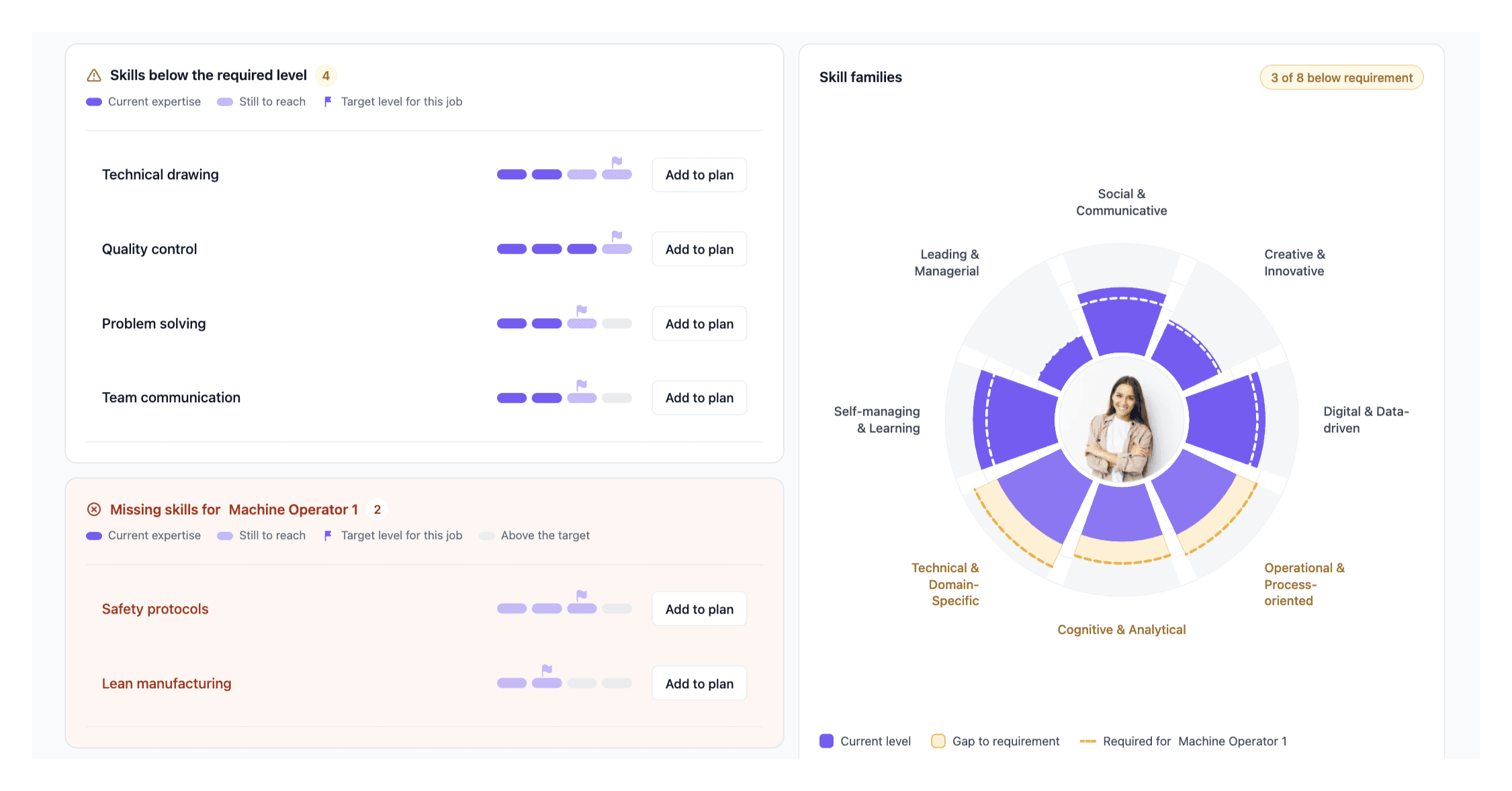
Skills gap analysis that shows if an employee is ready
Compare a person against the job they hold, or a job they might move into. See which skills fall short, by how much, and what closes the distance.
The problem
A manager wants to move someone into a more demanding job. The conversation runs on impressions, a performance review from eight months ago, gut feelings, and whatever the manager happens to remember.
Nobody can name the specific competency gaps the employee has and the development conversations stay vague.
Skills gap analysis makes that answer specific. It names the competency, the level required, and the gaps to cover.
Structured skill data
Most workforce tools describe people by title, tenure and headcount. Talentguide describes them by what they can actually do.
Our methodology is the set of choices that make that possible: how we model skills, where the data comes from, how we validate it, and where the line sits between what the system recommends and what people decide. And ultimately it all comes down to structuring skill data to be granular and traceable to evidence.


How it works
Step 1: Define what the job needs
Set the skills a job requires, and the expertise level required for each. Talentguide can extract this all out of job descriptions, vacancies, work instructions…
Step 2: Complete the skill profile
Upload existing documents, assess the person.. provide any information about the employee to create and validate the current skill profile of an employee.
Step 3: Vizualise skill gaps between person and job
The gap per skill becomes visible.
Step 4: Act on the skill gaps
From the gaps you can easily create a development plan, with initiatives to upskill an employee.
Every skills gap comes with something to do about it
Identifying a gap is the first step. The harder question is what that person does about it on Monday.
In talentguide, each gap connects to a development plan. Progress against the plan updates the skill profile as it happens, so the analysis stays current instead of aging into another snapshot.
The employee sees the same picture the manager sees. That transparency keeps everyone accountable and objective.
Talentguide AI
AI suggests. You decide.
AI does the heavy lifting: reading unstructured data, extracting skills, suggesting proficiency levels, surfacing gaps, proposing coaches and matching learning. But the decisions stay with the people accountable for them.
Every recommendation is a starting point for a human decision, never a replacement for one. That is also what keeps your skills decisions explainable and auditable, which matters more each year as the EU AI Act raises the bar for how automated systems are used in HR.
Transparency
Trace every skill to evidence.
A skills profile is only as trustworthy as the evidence behind it. Every skill and proficiency level traces back to a source: a document, an evaluation, or a human validation.
Confidence is explicit. Where the evidence is thin, the data is marked low-confidence rather than presented as fact. That honesty is deliberate. Treating every data point as equally certain is how skills tools lose the trust of the people who have to use them, especially technical teams who will not accept an assessment they cannot interrogate. When you can see where a skill came from and how confident the system is, the decision you make on top of it holds up.
Start planning your workforce better
Free trial for up to 5 employees