Skills-based workforce planning for every team, line, and machine
Build skill profiles of your people and your roles in one shared taxonomy. The taxonomy connects to the tools you already schedule with.
One layer, so everyone knows what your workforce can do, where you are exposed, and who can step in.
The problem
Your planning is only as good as the data behind it.
What if most of your planning data is outdated, not connected, missing, or in someone's head?
Job titles are inaccurate. Two people with the same title can do completely different work, and your planning cannot tell them apart.
The skills you do have on record go stale the moment a role changes. Roles change constantly.
Your HR system knows who works here. Your scheduling tool knows who works when. The two do not talk to each other.
Or knowledge of what someone can do lives in your best planner's head. When they leave, it leaves with them.
So how do you plan around that?
How it works
From unstructured workforce data
to skill-based planning.
Skills-based workforce planning, built on data you already own
Skills come out of the sources you already have: machine instructions, job descriptions, performance reviews, training records.. Each one becomes part of a skill profile for a person and for a job.

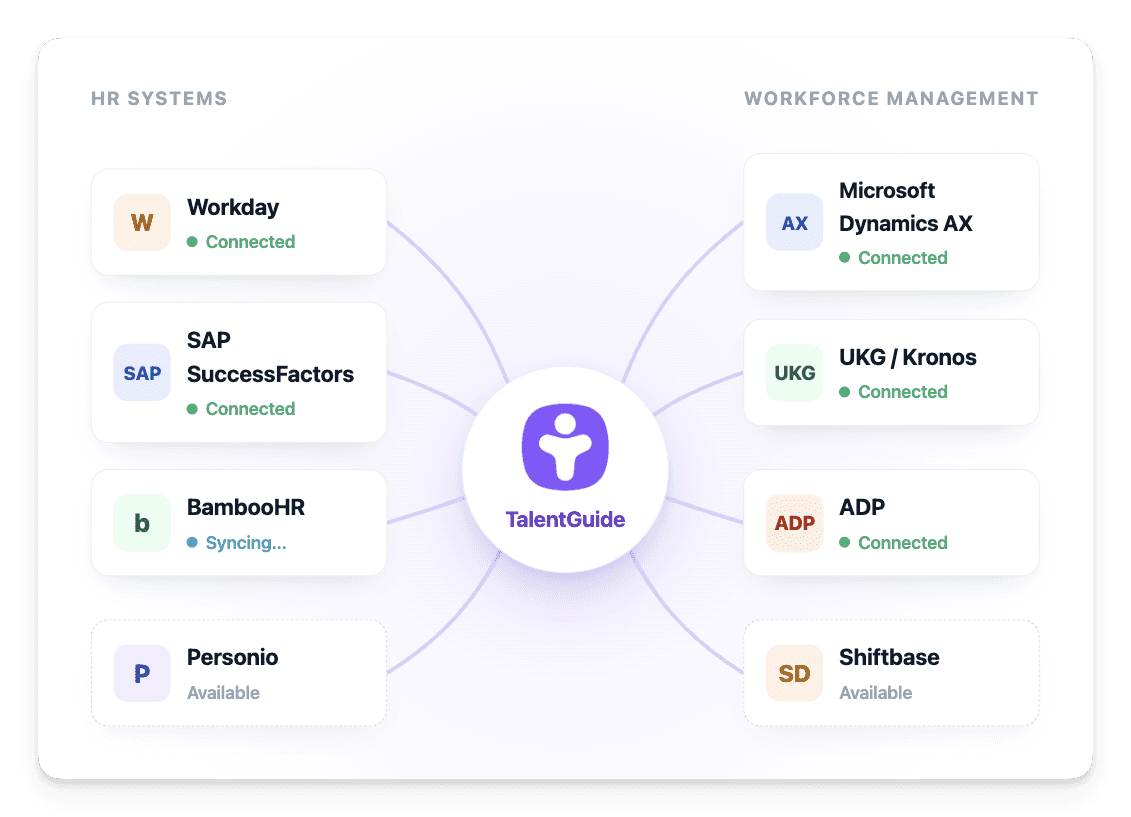
The layer between your HR system and your planning tools
Your HRIS knows who works here, your workforce management tool knows who works when. That missing layer sits between them, and integrates with them, so capability, people, and schedules line up in one place.
Capability and skill matrices across every line and department
See which skills are covered, at risk, or missing across a factory, a line, a department, or a team. The people who are a single point of failure appear before their absence becomes a problem.

Talentguide AI
AI suggests, people control.
A machine instruction looks like one document, yet it describes several distinct elements: reading the control panel, recognizing a fault, knowing when to stop the line.
We name those sub-skills separately and group into skills your whole organization reads the same way, rated on a scale that fits the work.
Evidence sets the weight. A certification outweighs a self-report, and a self-report still counts for something.
You keep control and can adjust any conclusion.
Where confidence runs low, it is sent to review for you to validate.
Start planning your workforce better
Free trial for up to 5 employees