
How we structure skills, and why it works.
Talentguide is built on one idea: workforce decisions get better when they read from structured, evidence-based skills data instead of job titles and guesswork. This is the methodology behind the platform.
Structured and traceable skill data
Most workforce tools describe people by title, tenure and headcount. Talentguide describes them by what they can actually do.
Our methodology is the set of choices that make that possible: how we model skills, where the data comes from, how we validate it, and where the line sits between what the system recommends and what people decide. And ultimately it all comes down to structuring skill data to be granular and traceable to evidence.

The core
talentguide™ Library
3-layered skills model
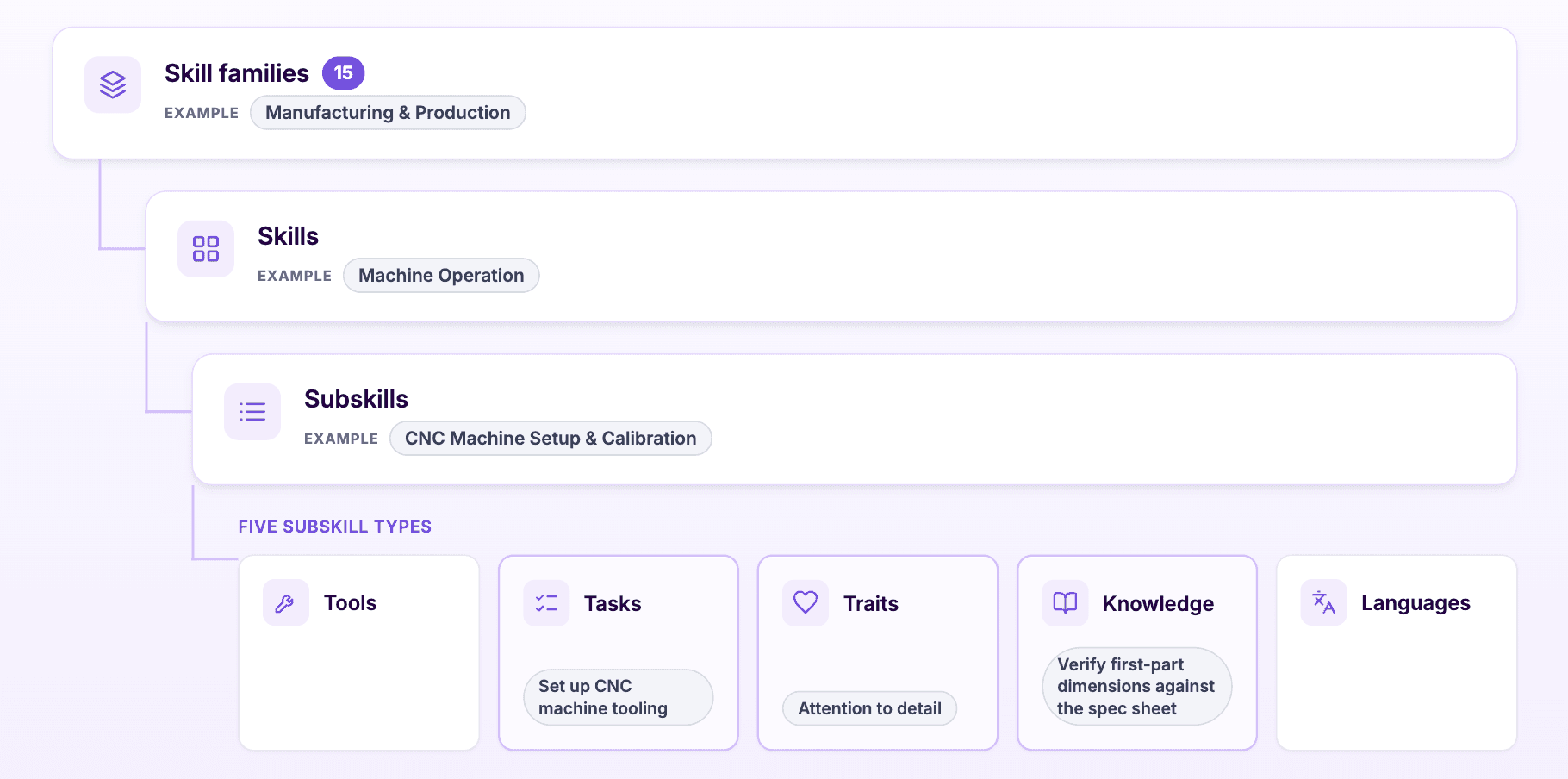
We structure skills in three layers: skill families, skills, and sub-skills.
Sub-skills are the concrete building blocks of a skill, and consist out of different types that define them, like a trait, task, tool, knowledge or language.
A skill is an expression of its sub-skills.
This granularity is intended.
Coarse skill labels make gap analysis vague and development generic. Sub-skill resolution lets talentguide show exactly which element a person is missing and target development at that element specifically, which is what makes both the gap analysis credible and the plan actionable.
Build on established standards, then goes deeper
Our taxonomy is grounded in ESCO and O*NET, established international standards for occupations and skills, and extended with sector-specific and operational skills those libraries leave thin.
That extension matters most on the shop floor. Standard libraries map office and knowledge roles well and describe the warehouse, the production line and the field technician poorly. If your workforce is largely operational, this is where a generic skills tool quietly fails you. Here, technical tasks, tools, and certifications with expiry dates are modelled at the same depth as any office skill, so the people hardest to describe are finally described properly.
Start from jobs, then people
You start by structuring your job architecture into a skills-based job architecture. This gives you your own skills taxonomy, built from your real roles rather than a generic template, and it becomes the foundation everything else reads from.
Then each employee gets a validated skills profile against that same structure, built from the data you already hold: CVs, job descriptions, evaluations, work instructions and internal documents, mapped to the taxonomy down to the sub-skill. Because your jobs and your people are described in the same skills language, any profile can be compared directly against any role, and a gap means the same thing everywhere it appears.

Talentguide AI
AI suggests. You decide.
AI does the heavy lifting: reading unstructured data, extracting skills, suggesting proficiency levels, surfacing gaps, proposing coaches and matching learning. But the decisions stay with the people accountable for them.
Every recommendation is a starting point for a human decision, never a replacement for one. That is also what keeps your skills decisions explainable and auditable, which matters more each year as the EU AI Act raises the bar for how automated systems are used in HR.
Transparancy
Trace every skill to evidence.
A skills profile is only as trustworthy as the evidence behind it. Every skill and proficiency level traces back to a source: a document, an evaluation, or a human validation.
Confidence is explicit. Where the evidence is thin, the data is marked low-confidence rather than presented as fact. That honesty is deliberate. Treating every data point as equally certain is how skills tools lose the trust of the people who have to use them, especially technical teams who will not accept an assessment they cannot interrogate. When you can see where a skill came from and how confident the system is, the decision you make on top of it holds up.
Start planning your workforce better
Free trial for up to 5 employees